


By Franky Nguyen, AVF Decolletage
Table of Contents
- Introduction
- Why Choosing the Right CNC Supplier Matters
- What Makes a Good CNC Supplier
- 10 Key Evaluation Criteria
- Real-World Risks of Choosing the Wrong Supplier
- Why AVF Decolletage
- Frequently Asked Questions (FAQ)
- Conclusion
Introduction
What makes a good CNC supplier?
This is one of the most important questions for engineers, sourcing managers, and buyers working with precision machined components.
Many companies make the mistake of choosing a CNC supplier based only on price. However, in reality, a low price often leads to higher total cost due to:
- Quality issues
- Production delays
- Assembly failures
- Rework and scrap
At AVF Decolletage, we frequently work with customers who switched suppliers after experiencing these problems.
Understanding what makes a good CNC supplier is critical to building a reliable and scalable supply chain.
👉 Related reading:
https://avfdecolletage.com/hidden-costs-cnc-machining/
Why Choosing the Right CNC Supplier Matters
A CNC supplier is not just a vendor — it is a strategic manufacturing partner.
The right supplier can:
✔ Improve product quality
✔ Reduce long-term cost
✔ Ensure consistent production
✔ Support engineering improvements
On the other hand, the wrong supplier can create hidden risks that only appear later in production or assembly.
One of the most common issues is tolerance accumulation, where parts meet individual specifications but fail during assembly.
👉 Learn more:
https://avfdecolletage.com/tolerance-stack-up-explained-machined-parts/
What Makes a Good CNC Supplier
A good CNC supplier is defined by capability, consistency, and collaboration.
It’s not just about machines — it’s about:
- Process control
- Engineering expertise
- Communication
- Reliability
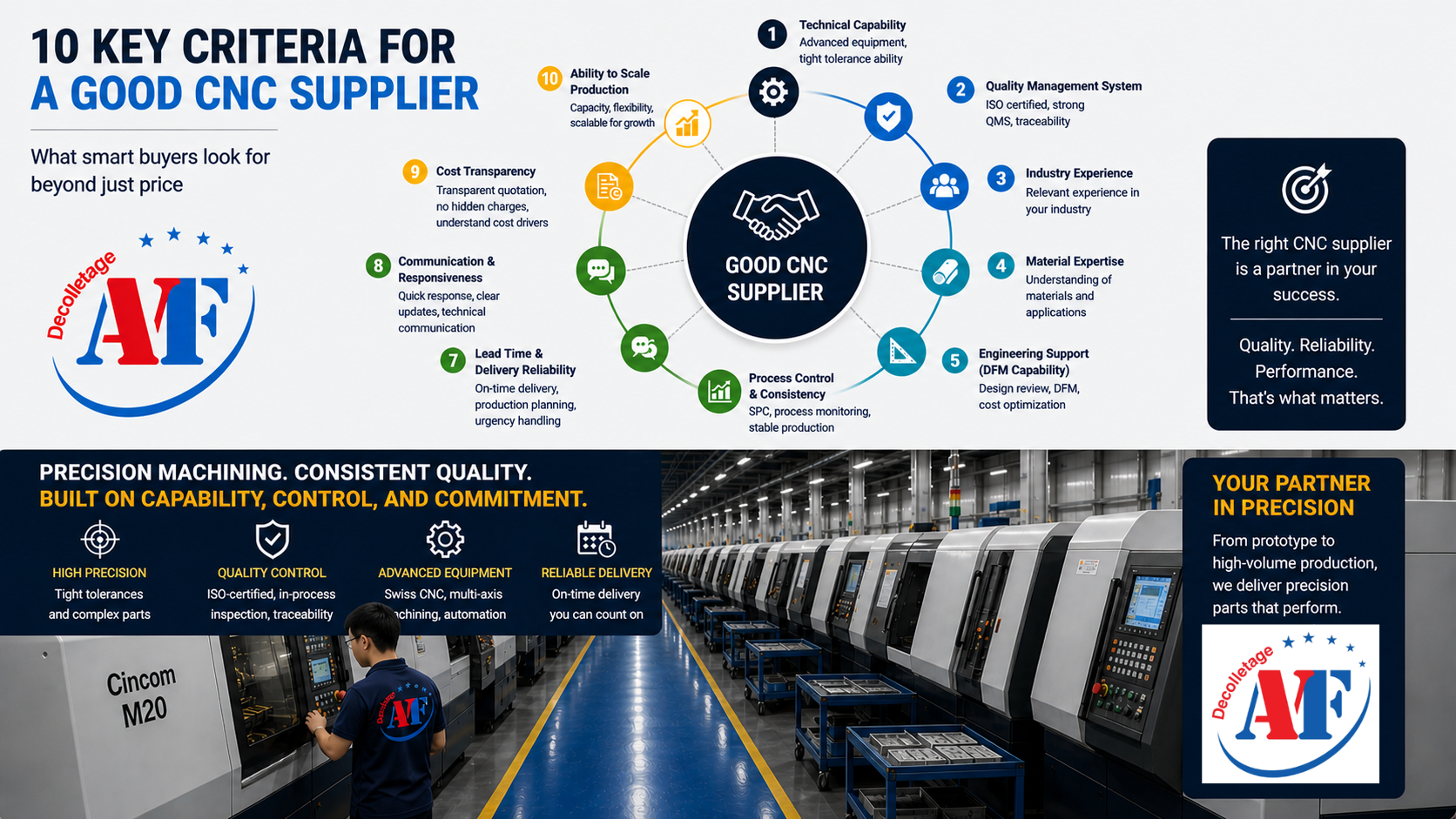
Let’s break down the 10 key evaluation criteria.
10 Key Evaluation Criteria
1. Technical Capability
A strong CNC supplier must have the right machines and expertise.
This includes:
- Swiss CNC and multi-axis machining
- Ability to produce complex geometries
- Tight tolerance capability (±0.005 mm or better)
Without the right capability, defects are unavoidable — no matter how good the inspection is.
Precision machining often follows industry standards such as GD&T to control tolerances and ensure proper function. For a deeper technical reference, ASME provides detailed guidelines:
👉 https://www.gdandtbasics.com/gdt-symbols/
2. Quality Management System (QMS)
Quality is not inspection — it is a system.
A reliable supplier should have:
- ISO 9001 or AS9100 certification
- Control plans and documented processes
- Full traceability of materials
This ensures consistency across production batches.
Precision machining relies on standardized tolerancing methods such as GD&T to ensure proper fit and function. For a clear explanation of GD&T symbols and applications, you can refer to:
👉 https://www.gdandtbasics.com/gdt-symbols/
3. Industry Experience
Different industries require different levels of precision and compliance.
For example:
- Aerospace → strict tolerances and traceability
- Connectors → electrical performance and precision
- Automotive → high-volume stability
A supplier experienced in your industry can prevent costly mistakes.
4. Material Expertise
Material selection directly impacts performance and manufacturability.
A good CNC supplier should:
- Understand material properties
- Recommend alternatives when needed
- Source certified materials
👉 Real example:
https://avfdecolletage.com/cracking-during-crimping/
Improper material selection can lead to failures such as cracking during assembly.
5. Engineering Support (DFM Capability)
A good supplier does more than produce parts — they improve them.
Design for Manufacturability (DFM) helps:
- Reduce machining cost
- Improve production efficiency
- Prevent defects
In many cases, DFM can reduce cost by 20–30%.
6. Process Control & Consistency
Consistency is critical, especially for high-volume production.
Look for:
- Statistical Process Control (SPC)
- Tool wear monitoring
- Stable machining parameters
Without process control, variation increases — even if initial samples are good.
Statistical Process Control (SPC) is widely used to monitor and maintain production consistency. You can explore how SPC works from NIST (National Institute of Standards and Technology):
👉 https://www.nist.gov
7. Lead Time & Delivery Reliability
Delivery performance directly impacts your supply chain.
A good CNC supplier should:
- Maintain high on-time delivery rates
- Provide realistic lead times
- Handle urgent orders when necessary
Late deliveries can delay your entire production line.
8. Communication & Responsiveness
Communication is often underestimated but critical.
A reliable supplier:
- Responds quickly
- Provides clear updates
- Supports technical discussions
Poor communication leads to misunderstandings and project delays.
9. Cost Transparency
A low price does not always mean a low total cost.
A good CNC supplier should:
- Clearly explain cost drivers
- Provide transparent quotations
- Avoid hidden charges
👉 Learn more:
https://avfdecolletage.com/hidden-costs-cnc-machining/
10. Ability to Scale Production
A supplier must grow with your business.
This includes:
- Capacity for high-volume production
- Flexible manufacturing systems
- Proven scalability
A supplier that works for prototypes may not be suitable for mass production.
Real-World Risks of Choosing the Wrong Supplier
Choosing the wrong CNC supplier often leads to problems such as:
⚠️ Common Issues:
- Parts pass inspection but fail in assembly
- High rejection rates
- Inconsistent quality between batches
- Unexpected cost increases
These issues are often linked to poor process control or lack of engineering support.
👉 Related reading:
https://avfdecolletage.com/tolerance-stack-up-explained-machined-parts/
Why AVF Decolletage
At AVF Decolletage, we focus on being more than just a supplier — we are a long-term manufacturing partner.
✔ Our strengths:
- Advanced Swiss CNC machining capability
- Strong quality management system
- Deep expertise in brass, aluminum, and stainless steel
- Proven high-volume production capability
- Dedicated engineering and DFM support
We work closely with customers to:
- Optimize designs
- Improve production stability
- Deliver consistent quality
👉 Request a quote:
https://avfdecolletage.com/request-for-quote/
Frequently Asked Questions (FAQ)
Q1: What makes a good CNC supplier?
A good CNC supplier combines technical capability, quality systems, engineering support, and reliable delivery.
Q2: Should I choose a CNC supplier based only on price?
No. The lowest price often leads to higher total cost due to defects, delays, and rework.
Q3: How can I evaluate a CNC supplier’s capability?
Review their machines, certifications, past projects, and ability to handle similar parts.
Q4: Why is DFM important when choosing a supplier?
DFM helps optimize part design, reduce cost, and improve manufacturability.
Q5: What is the biggest risk when choosing the wrong supplier?
Parts may meet drawing requirements but fail during assembly due to tolerance or process issues.
Q6: Can one supplier handle both prototype and mass production?
Yes, but you must verify their scalability and process stability.
Q7: How important is communication in CNC machining projects?
Very important. Poor communication often leads to delays, errors, and misunderstandings.
Conclusion
Understanding what makes a good CNC supplier is essential for any company working with precision machined parts.
The right supplier will:
✔ Improve product quality
✔ Reduce total cost
✔ Ensure consistent delivery
✔ Support long-term growth
At AVF Decolletage, we help customers build reliable supply chains — not just parts.
👉 Explore more insights:
https://avfdecolletage.com/category/blog/