


By Franky Nguyen, AVF Decolletage
Table of Contents
- Introduction
- What Is Miniaturization in Connector Manufacturing
- Why Miniaturization Is Increasing
- Challenges of Miniaturization in Connector Manufacturing
- Real-World Manufacturing Impact
- How AVF Decolletage Solves These Challenges
- Frequently Asked Questions (FAQ)
- Conclusion
Introduction
Miniaturization in connector manufacturing is becoming increasingly important as industries demand smaller, lighter, and more advanced electronic systems.
From aerospace and medical devices to EVs and consumer electronics, connector components must now deliver high performance in extremely compact sizes. However, as parts become smaller, manufacturing complexity increases significantly.
These trends are making miniaturization in connector manufacturing one of the most important challenges for modern precision machining.
The growing demand for miniature connectors often leads to:
- Tight tolerance issues
- Material performance risks
- Higher production cost
- Inspection difficulty
At AVF Decolletage, we work closely with customers facing these challenges every day, especially in high-precision connector pins and sockets.
👉 Related reading:
https://avfdecolletage.com/tolerance-stack-up-explained-machined-parts/
What Is Miniaturization in Connector Manufacturing
Miniaturization refers to reducing the size of connector components while maintaining or improving performance.
Typical examples include:
- Micro connector pins
- Fine-pitch contacts
- Compact terminal systems
- Miniature electrical connectors
In many applications, connector diameters can be as small as:
👉 0.5 mm or below
At this scale, even minimal variation can significantly affect functionality and reliability.
Understanding miniaturization in connector manufacturing allows engineers to design components that are both functional and manufacturable.
👉 In simple terms:
Smaller parts require higher precision.
Why Miniaturization Is Increasing
Miniaturization is driven by several fast-growing industries.
🔹 Consumer Electronics
Modern devices continue to become thinner, smaller, and more compact.
🔹 Aerospace
Weight reduction improves fuel efficiency and overall system performance.
🔹 Medical Devices
Miniature connectors are essential for implants and portable medical equipment.
🔹 Automotive & EV
Compact electronic systems help optimize limited space inside vehicles.
As products continue shrinking, manufacturers must overcome increasingly difficult production challenges.
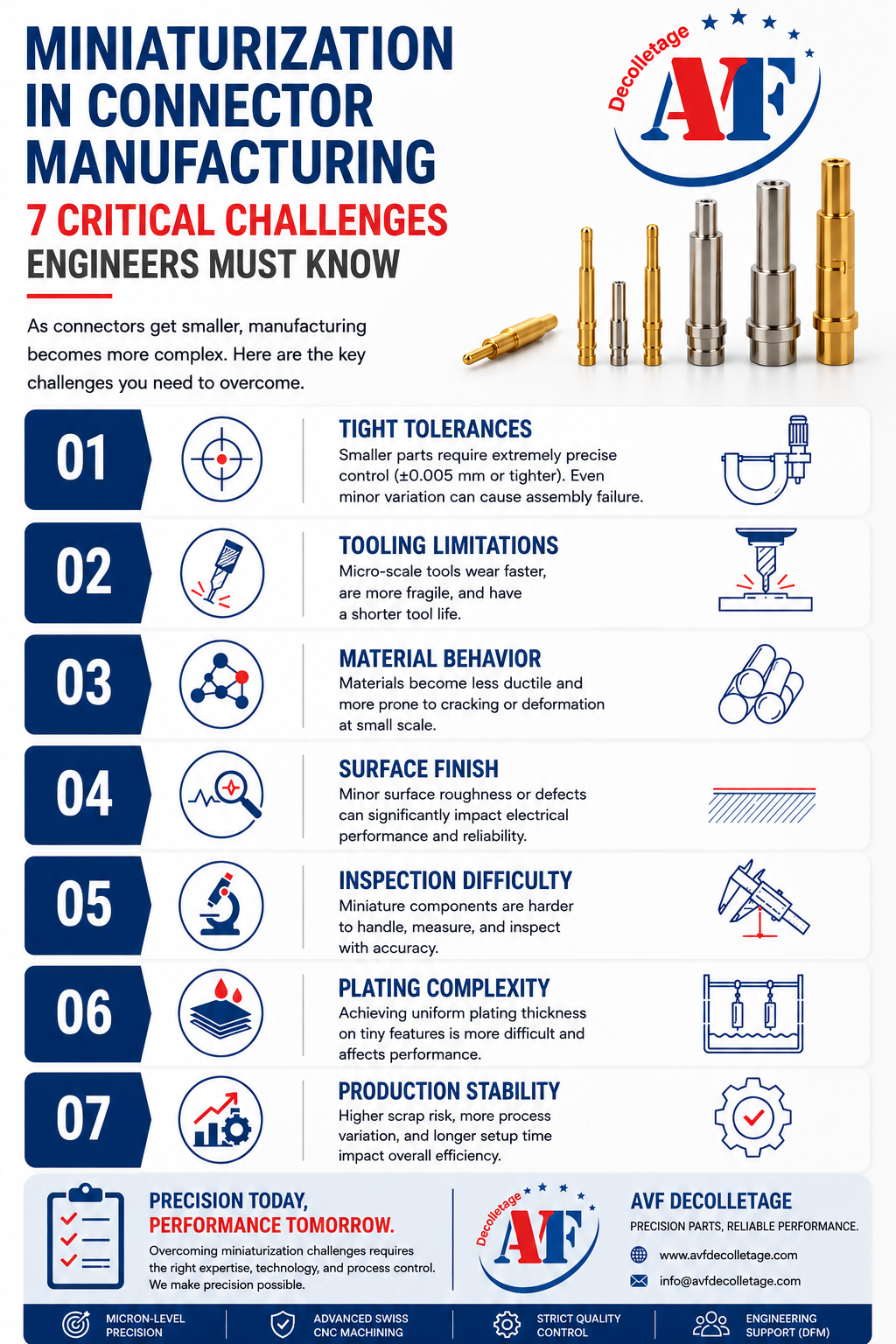
Challenges of Miniaturization in Connector Manufacturing
The following section highlights the most critical aspects of miniaturization in connector manufacturing.
1. Tight Tolerance Control
Tolerance control is one of the biggest concerns in miniaturization in connector manufacturing.
As components shrink, acceptable variation becomes extremely small.
⚠️ Challenge:
- ±0.005 mm or tighter
- Small deviations impact fit and performance
📊 Result:
Even minimal variation can cause:
- Misalignment
- Contact instability
- Assembly failure
👉 Learn more about tolerance control:
https://avfdecolletage.com/tolerance-stack-up-explained-machined-parts/
👉 GD&T fundamentals:
https://www.gdandtbasics.com/gdt-symbols/
2. Tooling Limitations
Micro machining requires extremely small cutting tools.
⚠️ Challenge:
- Faster tool wear
- Increased breakage risk
- Reduced tool life
At small scale, even slight tool vibration can impact part quality.
✅ Solution:
- High-quality tooling
- Stable machining conditions
- Controlled cutting parameters
3. Material Behavior at Small Scale
Materials behave differently when dimensions shrink.
⚠️ Challenge:
- Reduced ductility
- Higher stress concentration
- Increased cracking risk
This is especially important in connector pins and crimping applications.
👉 Real-world example:
https://avfdecolletage.com/cracking-during-crimping/
4. Surface Finish Requirements
Surface quality becomes much more critical at micro scale.
⚠️ Challenge:
- Roughness affects conductivity
- Small scratches become major defects
📊 Impact:
Poor surface finish can lead to:
- Higher electrical resistance
- Reduced reliability
- Faster wear
5. Inspection Difficulty
Miniature components are significantly harder to:
- Handle
- Measure
- Inspect accurately
⚠️ Challenge:
Standard measuring tools may not provide sufficient accuracy.
✅ Solution:
- Optical inspection systems
- Digital measurement technology
- High-magnification inspection
6. Plating and Coating Complexity
Miniature connector components require highly uniform plating.
⚠️ Challenge:
- Uneven plating thickness
- Poor coating adhesion
- Increased electrical variation
📊 Result:
Electrical performance and corrosion resistance may decrease.
7. Production Stability
As part size decreases, production becomes more sensitive to variation.
⚠️ Challenge:
- Higher scrap rates
- Longer setup time
- Increased process instability
Successfully managing miniaturization in connector manufacturing requires both engineering expertise and advanced machining capability.
👉 Learn more about machining cost factors:
https://avfdecolletage.com/hidden-costs-cnc-machining/
👉 ISO quality systems overview:
https://www.iso.org/iso-9001-quality-management.html
Real-World Manufacturing Impact
In production environments, miniaturization challenges often result in:
- Increased rejection rates
- Assembly failures
- Higher manufacturing cost
- Longer development cycles
For example, a connector pin design that works perfectly at 2 mm diameter may fail when reduced to 0.8 mm because:
- Structural strength decreases
- Tolerance sensitivity increases
- Material stress becomes concentrated
This highlights the importance of strong alignment between engineering design and manufacturing capability.
How AVF Decolletage Solves These Challenges
At AVF Decolletage, we address these challenges through:
✔ Advanced Swiss CNC Machining
Stable precision machining for micro-scale components.
✔ Material Expertise
Optimized material selection based on both performance and manufacturability.
✔ Process Control
Tool monitoring and controlled machining parameters ensure stable production.
✔ Inspection Capability
High-resolution optical systems for accurate measurement and verification.
✔ Engineering Support (DFM)
Design optimization support for miniature connector components.
👉 Request a quote:
https://avfdecolletage.com/request-for-quote/
Frequently Asked Questions (FAQ)
Q1: Why is miniaturization in connector manufacturing increasing?
Because modern electronic systems require smaller and lighter components with higher performance.
Q2: What is the biggest challenge in miniaturization?
Tolerance control and process stability are among the biggest challenges.
Q3: Can CNC machining produce miniature connector parts?
Yes. Swiss CNC machining is commonly used for precision micro components.
Q4: How does miniaturization affect manufacturing cost?
It increases cost due to tighter tolerances, specialized tooling, and inspection complexity.
Q5: Why is inspection difficult for miniature components?
Because standard measurement systems may not provide enough accuracy at micro scale.
Q6: How does AVF Decolletage support miniature connector manufacturing?
Through advanced machining, engineering support, and high-precision inspection systems.
Conclusion
Miniaturization in connector manufacturing is transforming the precision machining industry.
As electronic systems continue shrinking, manufacturers must achieve:
✔ Higher precision
✔ Better process control
✔ More stable production
Successfully addressing miniaturization in connector manufacturing requires experience, engineering expertise, and advanced machining capability.
At AVF Decolletage, we specialize in solving challenges related to miniaturization in connector manufacturing and helping customers produce reliable, high-performance connector components.
👉 Explore more technical insights:
https://avfdecolletage.com/category/blog/