


By Franky Nguyen, AVF Decolletage
Table of Contents
- Introduction
- What Is Tolerance Stack-Up?
- Tolerance Stack-Up Explained: Why It Causes Assembly Failures
- 6 Critical Factors That Cause Stack-Up Issues
- Real-World Example of Tolerance Stack-Up
- How to Control Tolerance Stack-Up
- Conclusion
- FAQ
Introduction
Tolerance stack-up explained is one of the most critical concepts in precision machining, especially when multiple components must fit together perfectly.
In many cases, parts are manufactured within tolerance, pass inspection, and meet all dimensional requirements. However, once assembled, the final product may still fail due to accumulated variation.
This issue can result in:
- Misalignment between components
- Functional failure in assemblies
- Increased wear and reduced lifespan
- Costly rework or scrap
At AVF Decolletage, we frequently see customers facing these challenges — particularly in connector systems, aerospace components, and precision assemblies.
Understanding tolerance stack-up explained in real-world applications is essential for ensuring that parts not only meet specifications individually but also function correctly together.
What Is Tolerance Stack-Up?
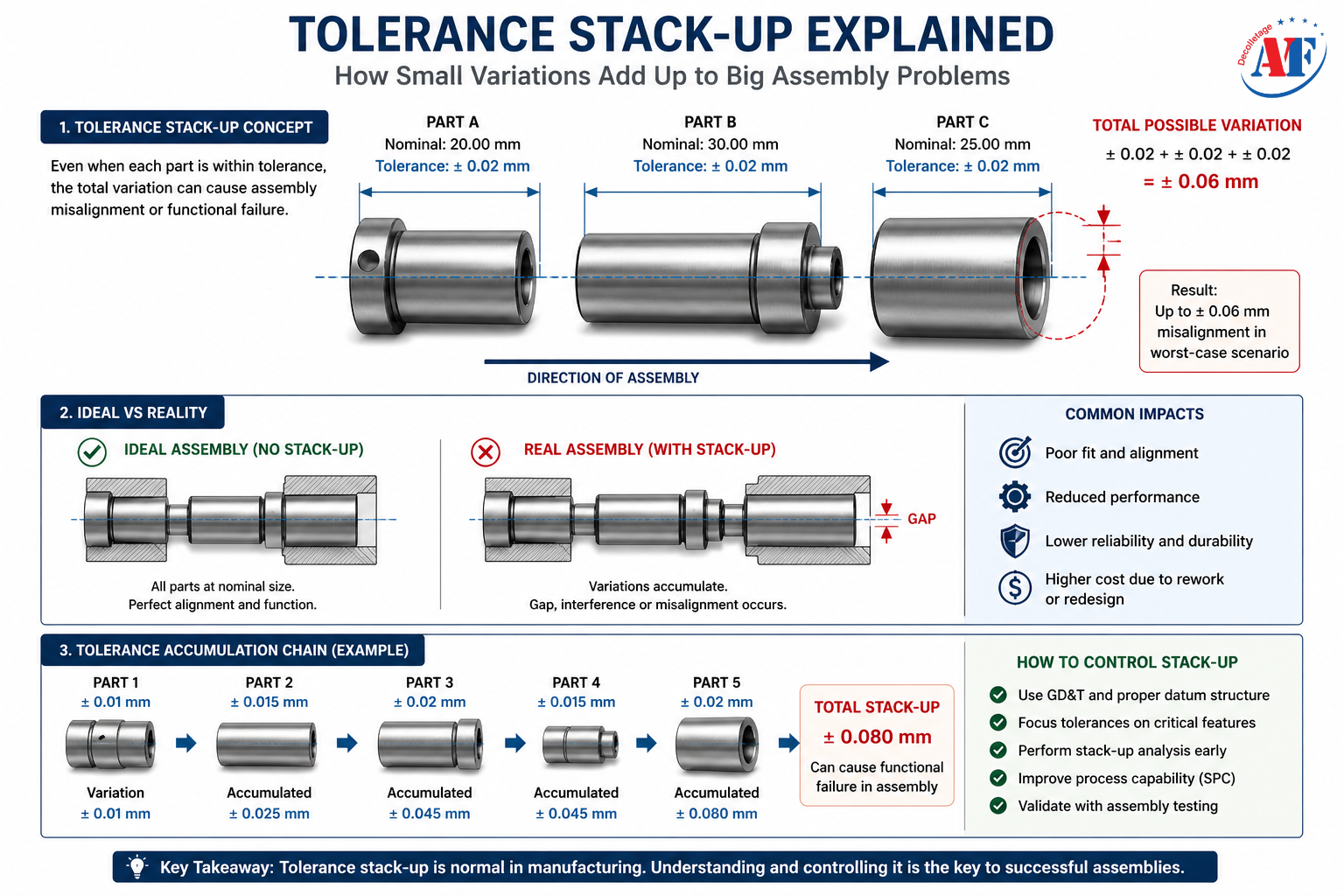
Tolerance stack-up refers to the accumulation of dimensional variations across multiple components in an assembly.
Even when each individual part is within its tolerance range, the combined effect can exceed acceptable limits.
📐 Example:
- Part A: ±0.02 mm
- Part B: ±0.02 mm
- Part C: ±0.02 mm
👉 Worst-case scenario:
Total variation = ±0.06 mm
This tolerance stack-up explained example shows how even small variations can lead to significant assembly issues.
👉 In simple terms:
Individual tolerance OK ≠ Assembly OK
Tolerance Stack-Up Explained: Why It Causes Assembly Failures
Understanding tolerance stack-up explained is essential because it directly impacts assembly performance.
⚙️ 1. Poor Fit and Alignment
Parts may not align correctly, causing assembly difficulties.
⚙️ 2. Functional Failure
Critical interfaces (electrical, mechanical, sealing) may fail.
⚙️ 3. Reduced Reliability
Misalignment increases stress and wear over time.
⚙️ 4. Increased Manufacturing Cost
Rework, sorting, and redesign drive up costs.
👉 Related reading:
Hidden Costs in CNC Machining
https://avfdecolletage.com/hidden-costs-in-cnc-machining/
6 Critical Factors That Cause Stack-Up Issues
1️⃣ Overly Loose or Misplaced Tolerances
Not all dimensions are equally important.
If tolerances are applied incorrectly, variation accumulates where it matters most.
👉 Solution:
Focus tight tolerances only on critical features.
2️⃣ Incorrect Datum Selection
Datums define how parts are measured and assembled.
Poor datum selection leads to inconsistency between machining and assembly.
👉 According to GD&T standards:
https://www.gdandtbasics.com/gdt-symbols/
👉 Solution:
Use consistent datum structures aligned with function.
3️⃣ Accumulation Across Multiple Components
The more parts involved, the higher the variation.
Even small tolerances multiply across assemblies.
👉 Solution:
Reduce part count or tighten key tolerances.
4️⃣ Manufacturing Process Variation
Even precision CNC machining introduces variation due to:
- Tool wear
- Thermal expansion
- Machine stability
👉 Solution:
Use SPC (Statistical Process Control) and monitor trends.
5️⃣ Poor Communication Between Teams
Design, machining, and inspection must align.
Miscommunication leads to incorrect assumptions about fit.
👉 Solution:
Implement early DFM (Design for Manufacturability) reviews.
6️⃣ Ignoring Functional Requirements
Not all dimensions affect performance equally.
Tolerance must be based on function, not just geometry.
👉 Solution:
Define critical-to-function features clearly.
Real-World Example of Tolerance Stack-Up
In real production, tolerance stack-up is rarely theoretical.
For example, in connector assemblies, we often observe:
- Slight diameter variation in pins
- Minor misalignment in housing components
- Accumulated deviation across multiple parts
Individually, each part passes inspection. However, when assembled:
- Contact pressure changes
- Electrical conductivity is affected
- Mechanical stress increases
This is why tolerance stack-up explained in real applications is critical — not just during design, but throughout manufacturing and validation.
At AVF Decolletage, we address this by combining:
- Tight process control
- Material consistency
- Assembly validation testing
How to Control Tolerance Stack-Up
Controlling tolerance stack-up requires a system-level approach.
✔ Best Practices:
🔹 Use GD&T Properly
- Use position instead of concentricity
- Apply runout for rotational features
🔹 Perform Stack-Up Analysis
- Worst-case analysis
- Statistical analysis
🔹 Optimize Design
- Reduce unnecessary features
- Add alignment references
🔹 Control Manufacturing Process
- Maintain machine stability
- Monitor tool wear
🔹 Validate Through Testing
- Assembly trials
- Functional verification
👉 Learn more about machining quality:
https://avfdecolletage.com/
Conclusion
Tolerance stack-up explained is not just a theoretical concept — it is a critical factor that determines whether assemblies succeed or fail.
Even when individual parts meet specifications, the combined variation can cause functional issues if not properly controlled.
By understanding and applying tolerance stack-up principles, manufacturers can:
- Improve assembly success
- Reduce production costs
- Enhance product reliability
At AVF Decolletage, we work closely with customers to analyze tolerance stack-up early — ensuring every component fits, functions, and performs as intended.
Because precision is not just about dimensions — it’s about how parts work together.
👉 Request a quote:
https://avfdecolletage.com/request-for-quote/
Frequently Asked Questions (FAQ)
Q1: What is tolerance stack-up?
It is the accumulation of dimensional variation across multiple parts.
Q2: Why do parts pass QC but fail in assembly?
Because combined variation exceeds functional limits.
Q3: How can tolerance stack-up be reduced?
Through better design, GD&T, and process control.
Q4: Is tighter tolerance always better?
No — it increases cost and should be applied strategically.
Q5: How does AVF Decolletage help?
We provide DFM support and manufacturing expertise to control stack-up.