


By Franky Nguyen, AVF Decolletage
Table of Contents
- Introduction
- What Is Design for Manufacturability (DFM)?
- Why DFM Matters in Precision Machining
- 8 Critical DFM Rules Engineers Must Follow
- Real-World Example of DFM Optimization
- How AVF Decolletage Supports DFM
- Conclusion
- FAQ
Introduction
Design for Manufacturability (DFM) is one of the most important — yet often underestimated — aspects of precision machining.
Many engineering designs focus heavily on functionality but overlook how easily a part can be manufactured. As a result, companies often face:
- Higher machining costs
- Longer lead times
- Increased scrap rates
- Unexpected production challenges
At AVF Decolletage, we regularly see designs that perform well on paper but create inefficiencies during production. The difference between a good design and a manufacturable design can significantly impact cost, quality, and delivery.
Understanding Design for Manufacturability (DFM) allows engineers to optimize their designs early — before production begins — saving both time and money.
👉 Learn more about our machining services:
https://avfdecolletage.com/services/
What Is Design for Manufacturability (DFM)?
Design for Manufacturability (DFM) is the practice of designing parts in a way that makes them easier, faster, and more cost-effective to produce.
It focuses on aligning design intent with manufacturing capabilities.
🔍 Key Objectives:
- Reduce complexity
- Improve consistency
- Minimize production cost
- Ensure quality and reliability
👉 In simple terms:
A well-designed part is not just functional — it is manufacturable.
Why DFM Matters in Precision Machining
Applying Design for Manufacturability (DFM) early in the design phase provides major benefits:
⚙️ 1. Lower Cost
Simpler designs reduce machining time and tooling requirements.
⚙️ 2. Faster Lead Time
Optimized designs reduce setup and production time.
⚙️ 3. Better Quality
Reduced complexity leads to more consistent results.
⚙️ 4. Higher Production Efficiency
DFM enables smoother transition from prototype to mass production.
👉 Related reading:
Hidden Costs in CNC Machining
https://avfdecolletage.com/hidden-costs-cnc-machining/
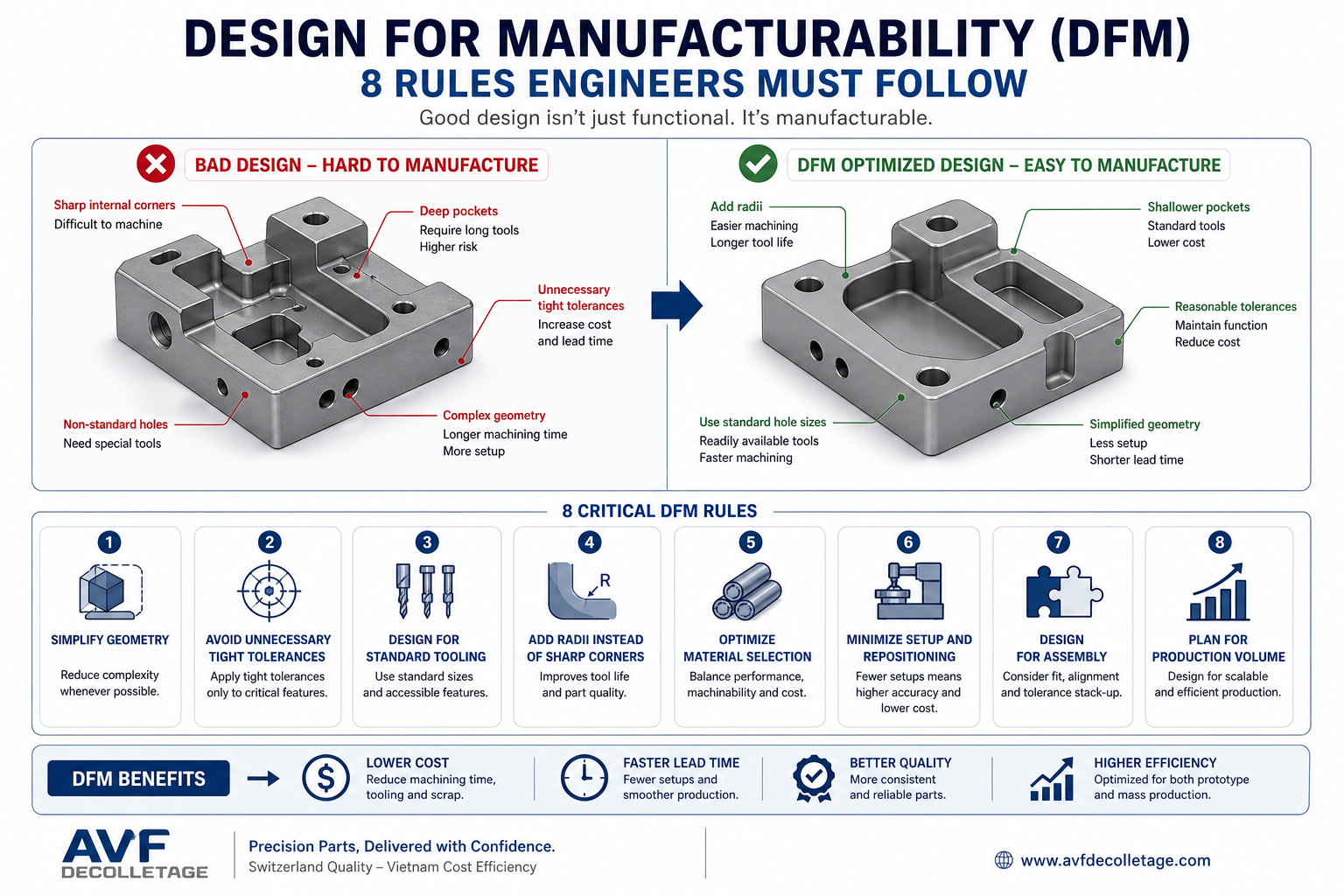
8 Critical DFM Rules Engineers Must Follow
1️⃣ Simplify Geometry Whenever Possible
Complex geometry increases machining difficulty.
⚠️ Common Issues:
- Deep pockets
- Thin walls
- Sharp internal corners
✅ Best Practice:
- Use simple shapes
- Avoid unnecessary features
- Reduce complexity without affecting function
👉 Simpler design = faster machining + lower cost
2️⃣ Avoid Unnecessary Tight Tolerances
Tight tolerances significantly increase cost.
⚠️ Problem:
Applying tight tolerance to non-critical features
📊 Example:
±0.005 mm vs ±0.02 mm can double machining time
✅ Best Practice:
- Apply tight tolerances only to critical features
👉 Learn more about tolerance control:
https://www.gdandtbasics.com/gdt-symbols/
3️⃣ Design for Standard Tooling
Custom tooling increases cost and lead time.
⚠️ Problem:
Non-standard hole sizes or unusual features
✅ Best Practice:
- Use standard drill sizes
- Design accessible features
- Avoid special tooling when possible
4️⃣ Add Radii Instead of Sharp Corners
Sharp internal corners are difficult to machine.
⚠️ Problem:
Tools cannot create perfectly sharp internal corners
✅ Best Practice:
- Add fillets or radii
- Match radius to tool size
👉 This improves tool life and machining speed
5️⃣ Optimize Material Selection
Material choice affects both machining and performance.
⚠️ Problem:
Choosing material based only on strength
🔍 Consider:
- Machinability
- Cost
- Availability
✅ Best Practice:
- Match material to application requirements
6️⃣ Minimize Setup and Repositioning
Multiple setups increase error risk.
⚠️ Problem:
Complex parts require multiple operations
✅ Best Practice:
- Design parts that can be machined in fewer setups
- Use single-axis alignment where possible
👉 Fewer setups = higher precision + lower cost
7️⃣ Design for Assembly
Parts should not only be manufacturable — they must assemble easily.
⚠️ Problem:
Ignoring fit and alignment
✅ Best Practice:
- Use alignment features
- Consider tolerance stack-up
- Design for easy assembly
👉 Related:
Tolerance Stack-Up Explained
https://avfdecolletage.com/tolerance-stack-up-machined-parts/
8️⃣ Plan for Production Volume
A design suitable for prototyping may not work for mass production.
⚠️ Problem:
Prototype design scaled directly to high volume
✅ Best Practice:
- Consider production method early
- Optimize for high-volume efficiency
👉 At AVF Decolletage, we adapt machining strategy based on volume
Real-World Example of DFM Optimization
In one project involving connector pins, the original design included:
- Sharp internal edges
- Tight tolerances across all features
- Non-standard dimensions
⚠️ Result:
- High machining cost
- Increased scrap rate
- Longer lead time
✅ DFM Improvements:
- Added radii to internal corners
- Relaxed non-critical tolerances
- Standardized dimensions
📊 Outcome:
- 20–30% cost reduction
- Improved production efficiency
- Better consistency
This example shows how Design for Manufacturability (DFM) directly impacts real-world results.
How AVF Decolletage Supports DFM
At AVF Decolletage, DFM is part of our process.
✔ What We Provide:
- Design review before production
- Cost optimization suggestions
- Material recommendations
- Process planning support
We work closely with customers to ensure designs are optimized for both performance and manufacturability.
👉 Request a quote:
https://avfdecolletage.com/request-for-quote/
Conclusion
Design for Manufacturability (DFM) is not just a design guideline — it is a critical factor that determines the success of a manufacturing project.
By applying DFM principles, engineers can:
- Reduce cost
- Improve quality
- Accelerate production
- Avoid common manufacturing issues
At AVF Decolletage, we help customers bridge the gap between design and production — ensuring that every part is not only functional but also optimized for manufacturing.
Because the best designs are not just engineered — they are engineered to be built.
Frequently Asked Questions (FAQ)
Q1: What is DFM?
It is designing parts for easier and more efficient manufacturing.
Q2: Why is DFM important?
It reduces cost, improves quality, and speeds up production.
Q3: Does DFM apply only to CNC machining?
No, it applies to all manufacturing processes.
Q4: Can DFM reduce cost significantly?
Yes, often by 20–30% or more.
Q5: How does AVF Decolletage help with DFM?
We provide design review and optimization before production.