


By Franky Nguyen, AVF Decolletage
Introduction
When evaluating CNC machining quotes, many buyers focus primarily on one number: the unit price.
However, in reality, that number rarely reflects the true cost of manufacturing.
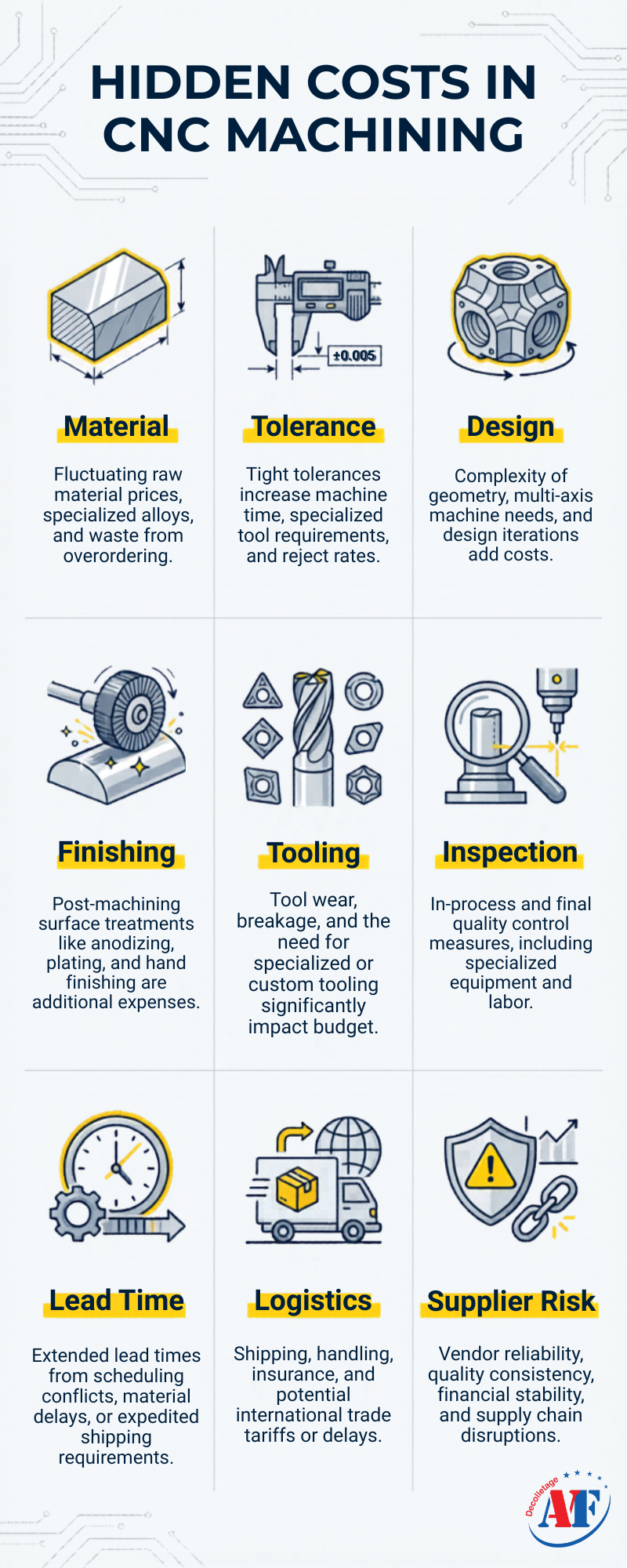
The hidden costs in CNC machining often lie beneath the surface — in material choices, design decisions, tolerances, production methods, and even logistics. These factors may not always be visible in a quotation, yet they can significantly affect total cost, lead time, and product performance.
For engineers and sourcing managers, understanding these hidden costs is critical. It allows you to move beyond price comparison and toward total cost optimization — a strategy that reduces risk while improving efficiency.
At AVF Decolletage, we work closely with customers to identify these cost drivers early, ensuring that every project is optimized not only for manufacturability, but also for long-term value.
In this article, we break down the most common hidden costs in CNC machining — and how to avoid them.
👉 Explore AVF Decolletage machining services
1️⃣ Material Selection Costs — More Than Just Price per Kg
Material is often the first cost element buyers consider — but it is also one of the most misunderstood.
🔍 Hidden Cost Drivers:
- Minimum Order Quantity (MOQ): Many materials must be purchased in large quantities
- Bar size vs part size mismatch: Leads to excessive scrap
- Availability: Long lead times can delay production
- Certification requirements: ROHS, REACH, DFARS increase sourcing complexity
For example, selecting a specialty alloy without considering MOQ may result in unused inventory — effectively increasing cost per part.
⚠️ Real Impact:
A material that is only 10% more expensive per kg can increase total cost by 30–40% when waste and MOQ are included.
AVF Insight:
We often help customers switch to alternative materials that meet the same performance requirements while significantly reducing cost and lead time.
2️⃣ Over-Specified Tolerances — Precision Comes at a Price
Tolerances are critical — but more precision always means more cost.
🔍 Hidden Cost Drivers:
- Slower machining speeds
- Increased tool wear
- Additional inspection requirements
- Higher rejection rates
📐 Example:
A tolerance of ±0.005 mm requires significantly more control than ±0.02 mm, often doubling machining time depending on geometry.
⚠️ Real Impact:
Many parts are over-specified due to design habits rather than functional necessity.
AVF Insight:
By reviewing drawings with customers, we often identify non-critical features where tolerances can be relaxed — reducing cost without affecting performance.
3️⃣ Complex Geometry — The Silent Cost Multiplier
Design complexity directly affects machinability.
🔍 Common Cost Drivers:
- Deep or narrow holes
- Thin walls prone to deformation
- Sharp internal corners
- Micro-scale features
These features require:
- Specialized tooling
- Multiple setups
- Reduced cutting speeds
⚠️ Real Impact:
Complex geometry can increase cycle time by 50–200%, especially in high-volume production.
AVF Insight:
Simple design modifications — such as adding radii or adjusting wall thickness — can dramatically improve efficiency.
4️⃣ Secondary Processes and Finishing — The Hidden Layers
Machining is only part of the process. Finishing often adds significant cost.
🔧 Common Secondary Processes:
- Deburring
- Heat treatment
- Plating (gold, nickel, tin)
- Passivation
🔍 Hidden Cost Drivers:
- Outsourcing coordination
- Additional quality control
- Logistics between suppliers
- Longer lead time
⚠️ Real Impact:
A part that requires plating may cost 2–3× more than machining alone.
AVF Insight:
We coordinate with trusted partners to ensure consistent finishing quality while minimizing delays.
5️⃣ Tooling and Setup Costs — The Hidden Startup Investment
Every new part requires setup.
🔧 Includes:
- CNC programming
- Tooling preparation
- Fixtures and jigs
- Thread rolling dies
🔍 Hidden Cost Drivers:
- Complex setups require more engineering time
- Tool wear during initial runs
- Low-volume orders absorb full setup cost
⚠️ Real Impact:
Small orders often appear expensive because setup costs are spread across fewer parts.
AVF Insight:
For repeat production, these costs are amortized — significantly reducing unit price over time.
6️⃣ Inspection and Quality Requirements — Necessary but Costly
Quality assurance is essential — especially in industries like aerospace and electronics.
🔍 Hidden Cost Drivers:
- First Article Inspection (FAI)
- PPAP / FAIR documentation
- Advanced inspection equipment
- Operator time
⚠️ Real Impact:
High-quality requirements can add 10–20% to total cost — but skipping them risks much higher losses.
AVF Insight:
We align inspection levels with customer requirements to ensure efficiency without compromising quality.
7️⃣ Lead Time and Urgency — Speed Has a Price
Fast delivery often comes at a premium.
🔍 Hidden Cost Drivers:
- Overtime production
- Priority scheduling
- Expedited material sourcing
- Air freight
⚠️ Real Impact:
Urgent orders can increase total cost by 20–50%.
AVF Insight:
Early planning is one of the simplest ways to reduce cost.
8️⃣ Logistics and Shipping — The Overlooked Expense
Shipping is often underestimated, especially for international customers.
🔍 Hidden Cost Drivers:
- Import tariffs and duties
- Packaging requirements
- Freight method (air vs sea)
- Damage risk and insurance
⚠️ Real Impact:
Shipping can represent 10–30% of total cost, depending on urgency and volume.
9️⃣ Supplier Capability and Experience — The Biggest Risk
Choosing the wrong supplier is the most expensive mistake.
🔍 Hidden Cost Drivers:
- Quality issues and rework
- Delays in delivery
- Communication gaps
- Lack of technical support
⚠️ Real Impact:
A cheap supplier can lead to:
- Production delays
- Customer dissatisfaction
- Increased long-term cost
AVF Insight:
An experienced supplier reduces risk — and risk equals cost.
🔟 The Cost of Poor Communication
Often overlooked, communication plays a major role.
🔍 Hidden Cost Drivers:
- Misinterpreted drawings
- Unclear specifications
- Delayed responses
- Rework due to misunderstanding
⚠️ Real Impact:
Poor communication leads to delays, scrap, and frustration.
AVF Insight:
Clear communication early prevents costly mistakes later.
Conclusion
The true cost of CNC machining goes far beyond the initial quote.
Hidden costs can arise from material selection, tolerances, design complexity, finishing, logistics, and supplier capability. Understanding these factors allows buyers to make better decisions — focusing not just on price, but on total value.
At AVF Decolletage, we take a transparent and collaborative approach — helping customers optimize every aspect of the manufacturing process.
Because in precision machining, the smartest decision isn’t always the cheapest — it’s the most informed.
👉 Request a quote: https://avfdecolletage.com/request-for-quote/
Frequently Asked Questions (FAQ)
Q1: Why do CNC machining quotes vary so much?
Because suppliers include different levels of material, quality, and process considerations.
Q2: How can I reduce hidden costs?
Optimize design, material, and tolerances, and work with an experienced supplier.
Q3: What is the most common hidden cost?
Over-specified tolerances and complex geometry.
Q4: Is cheaper always worse?
Not always — but extremely low quotes often exclude important factors.
Q5: How does AVF Decolletage help?
We provide DFM support, transparent pricing, and optimized manufacturing strategies.