


By Franky Nguyen, AVF Decolletage
Introduction
Threads are one of the most critical features in precision machined components — yet they are often underestimated.
Whether used in connectors, fasteners, valve components, or aerospace assemblies, threads directly impact strength, reliability, and assembly performance.
When it comes to manufacturing threads, engineers typically choose between two main processes:
👉 Thread Cutting
👉 Thread Rolling
At first glance, both methods produce similar geometries. However, their differences in strength, surface finish, production speed, and cost can significantly influence the final product.
At AVF Decolletage, we use both methods depending on application, material, and volume — especially for high-precision components produced on Swiss CNC and multi-spindle machines.
This article breaks down the differences, advantages, and limitations of each process — helping you choose the right method for your next project.
👉 Explore AVF Decolletage machining capabilities
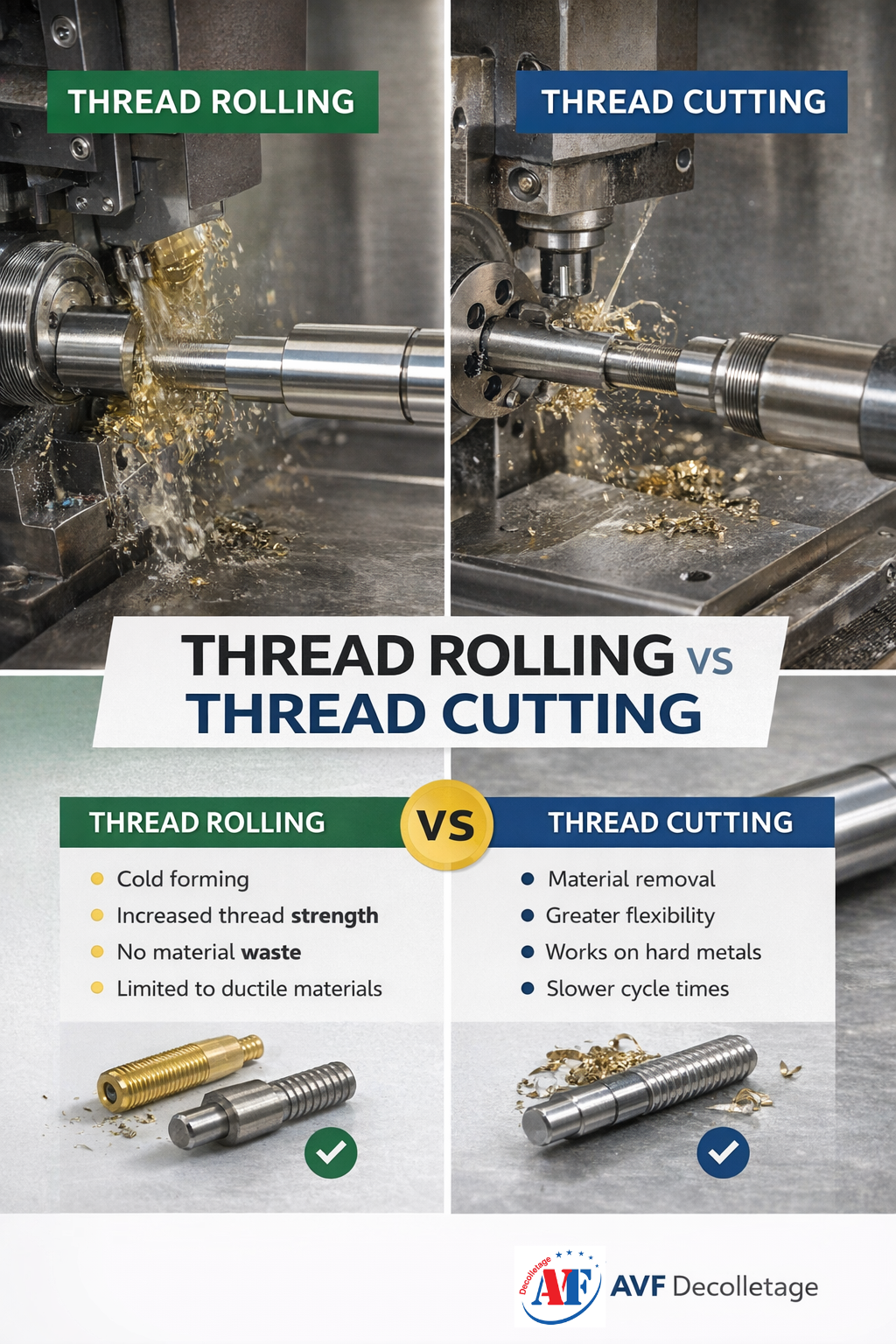
1️⃣ What Is Thread Cutting?
Thread cutting is a subtractive machining process where threads are created by removing material using tools such as:
- Single-point threading tools
- Taps
- Thread mills
- Dies
⚙️ How It Works
Material is progressively removed to form the thread profile, following the desired pitch and geometry.
🔩 Key Characteristics
- High flexibility (works for almost any geometry)
- Suitable for low to medium production volumes
- No material deformation — only removal
🏭 Advantages
✔ Can machine complex or custom thread forms
✔ Works on hard materials
✔ Ideal for prototype and small batch production
✔ No need for special rolling dies
⚠️ Limitations
- Weaker threads compared to rolling
- Surface finish depends on tool condition
- Slower production speed
- Generates chips and burrs
AVF Insight:
Thread cutting is often the best option when design flexibility is more important than production speed or strength.
2️⃣ What Is Thread Rolling?
Thread rolling is a cold forming process where threads are created by deforming the material rather than cutting it.
⚙️ How It Works
The material is pressed between hardened dies, forcing it to flow into the thread shape.
🔩 Key Characteristics
- No material removal
- Grain structure is preserved and strengthened
- Produces smooth, work-hardened surfaces
🏭 Advantages
✔ Stronger threads (up to 30% higher fatigue strength)
✔ Excellent surface finish
✔ No chips or material waste
✔ Faster cycle times in high-volume production
⚠️ Limitations
- Requires specific material ductility
- Higher tooling cost (rolling dies)
- Limited to standard thread forms
- Requires precise blank diameter control
AVF Insight:
Thread rolling is the preferred method for high-volume production and load-bearing applications.
3️⃣ Thread Strength: The Biggest Difference
One of the most important distinctions is mechanical strength.
🔩 Thread Cutting
- Cuts through grain structure
- Creates stress concentration points
- Lower fatigue resistance
🔩 Thread Rolling
- Compresses and aligns grain flow
- Improves tensile strength
- Enhances fatigue resistance
👉 In critical applications (automotive, aerospace, connectors), rolled threads are significantly more durable.
4️⃣ Surface Finish and Quality
Surface finish directly affects:
- Friction
- Wear
- Corrosion resistance
- Electrical contact (for connectors)
📐 Thread Cutting
- Rougher surface (tool marks)
- May require deburring or polishing
📐 Thread Rolling
- Smooth, burnished finish
- Better resistance to wear and corrosion
AVF Insight:
For connector components, smoother threads improve assembly consistency and reliability.
5️⃣ Production Speed and Cost
⚙️ Thread Cutting
- Slower process
- More tool wear
- Higher cost per part in large volumes
⚙️ Thread Rolling
- Faster cycle times
- Minimal material waste
- Lower cost per part in high volumes
👉 However, rolling requires initial investment in tooling, making it less suitable for small batches.
6️⃣ Material Considerations
Not all materials behave the same.
🧪 Thread Rolling Works Best With:
- Aluminum
- Brass (C36000, C17300)
- Low to medium carbon steel
- Some stainless steels (303, 304 with proper setup)
🧪 Thread Cutting Works Better For:
- Hard materials
- Brittle materials
- Exotic alloys
- Complex geometries
AVF Insight:
Material selection often determines which process is feasible.
7️⃣ Dimensional Accuracy and Consistency
📏 Thread Cutting
- Depends heavily on tool condition
- May vary over long production runs
📏 Thread Rolling
- Highly repeatable
- Excellent consistency in high volumes
This makes rolling ideal for automated production lines.
8️⃣ When to Use Each Method
✅ Choose Thread Cutting When:
- Low volume or prototype
- Custom thread geometry
- Hard or brittle material
- Tight internal threads
✅ Choose Thread Rolling When:
- High-volume production
- Standard thread profiles
- Strength is critical
- Smooth finish required
9️⃣ AVF Decolletage’s Approach
At AVF Decolletage, we don’t choose based on preference — we choose based on application.
We evaluate:
- Material type
- Production volume
- Mechanical requirements
- Cost targets
Our capabilities include:
✔ Swiss CNC threading
✔ Multi-spindle thread rolling
✔ Go/No-Go gauge inspection
✔ In-process thread verification
We also apply lessons learned from real production challenges — ensuring consistent quality and delivery.
Conclusion
Thread rolling and thread cutting both have their place in precision machining — but they serve different purposes.
- Thread cutting offers flexibility and adaptability
- Thread rolling delivers strength, consistency, and efficiency
Choosing the right process can significantly impact product performance, cost, and long-term reliability.
At AVF Decolletage, we help customers select the optimal method — ensuring that every thread meets both technical and commercial requirements.
Because in precision manufacturing, even the smallest details — like threads — make the biggest difference.
👉 Request a quote or consultation: https://avfdecolletage.com/request-for-quote/
Frequently Asked Questions (FAQ)
Q1: Are rolled threads stronger than cut threads?
Yes. Rolled threads have improved grain structure, making them stronger and more fatigue-resistant.
Q2: Can all materials be thread rolled?
No. Materials must have sufficient ductility. Hard or brittle materials are better suited for thread cutting.
Q3: Is thread rolling more expensive?
Initial tooling cost is higher, but per-part cost is lower in high-volume production.
Q4: Which process provides better surface finish?
Thread rolling produces smoother, burnished surfaces.
Q5: Does AVF Decolletage offer both methods?
Yes. We provide both thread cutting and thread rolling, selecting the best method based on application.