


By Franky Nguyen, AVF Decolletage
Introduction
The precision machining process is more than just cutting metal — it is a controlled system that transforms an engineering drawing into a high-performance finished component.
From aerospace to electronics and industrial applications, every step in the precision machining process directly impacts quality, cost, and reliability.
At AVF Decolletage, we manage this process end-to-end — ensuring consistency, traceability, and performance at every stage.
This article walks you through the complete lifecycle of a precision machined part, giving you a clear understanding of what happens behind the scenes.
👉 Explore AVF Decolletage services
1️⃣ Step 1: Engineering Drawing Review
Every project begins with a technical drawing — but before production starts, it must be thoroughly reviewed.
🔍 Key Checks Include:
- Dimensional tolerances
- Material specifications
- Surface finish requirements
- Thread standards and fits
- Critical-to-function features
⚠️ Common Issues Identified:
- Overly tight tolerances (increasing cost unnecessarily)
- Missing dimensions or unclear specifications
- Material mismatches
AVF Insight:
Early engineering feedback can reduce total production cost by 20–30%.
2️⃣ Step 2: Material Selection & Procurement
Material choice directly impacts:
- Machinability
- Strength
- Corrosion resistance
- Compliance (ROHS, REACH, DFARS)
🧪 Common Materials at AVF:
- Aluminum (6061, 2017)
- Brass (C36000, C17300, C54400)
- Stainless Steel (303, 304, 316, 416)
📄 Traceability
Each material batch comes with:
✔ Mill certificate
✔ Heat number
✔ Compliance documentation
3️⃣ Step 3: Process Planning & Tooling
Before machining begins, our engineering team defines the optimal manufacturing strategy.
⚙️ Key Decisions:
- Swiss CNC vs multi-spindle machine
- Thread cutting vs thread rolling
- Sequence of operations
- Tool selection and cutting parameters
🛠 Tooling Setup Includes:
- Custom fixtures
- Cutting tools
- Thread rolling dies (if applicable)
AVF Insight:
Proper process planning is the foundation of repeatability and cost control.
4️⃣ Step 4: CNC Machining in the Precision Machining Process
This is where raw material becomes a precision component.
🏭 Machining Technologies Used:
- Swiss CNC lathes (high precision, small parts)
- Multi-spindle CAM machines (high volume)
- CNC turning and milling
⚙️ What Happens During Machining:
- Turning, drilling, threading
- Grooving and profiling
- Deburring control
- Continuous monitoring
At AVF, we machine parts down to 0.5 mm diameter with ±0.005 mm tolerance.
5️⃣ Step 5: In-Process Quality Control
Quality is not inspected at the end — it is controlled throughout production.
📏 Inspection Methods:
- First Article Inspection (FAI)
- In-process checks by operators
- Go/No-Go gauges for threads
- SPC (Statistical Process Control)
🎯 Goal:
Detect and correct issues before they become defects.
6️⃣ Step 6: Secondary Processes & Finishing
Depending on the application, parts may undergo additional processes:
🔧 Common Finishing Services:
- Deburring
- Passivation (stainless steel)
- Plating (gold, nickel, tin)
- Heat treatment
AVF Insight:
We work with qualified external partners for plating to ensure global quality standards.
7️⃣ Step 7: Final Inspection & Documentation
Before shipment, every batch undergoes final verification.
📄 Documentation Provided:
- Material Certificate
- Inspection Report
- Certificate of Conformance (COC)
- ROHS / REACH / DFARS declarations (if required)
🔍 Final Checks Include:
- Dimensional verification
- Visual inspection
- Surface condition
- Packaging compliance
8️⃣ Step 8: Packaging & Logistics
Proper packaging ensures parts arrive undamaged and ready for use.
📦 Packaging Considerations:
- Protection from scratches and contamination
- Anti-corrosion measures
- Labeling and traceability
✈️ Shipping Options:
- Air freight (fast delivery)
- Sea freight (cost-effective)
- DDP / DAP / EXW options
AVF Insight:
We support customers with global logistics solutions, especially to the U.S. and Europe.
9️⃣ Step 9: Delivery & Customer Support
Delivery is not the end — it’s part of a continuous partnership.
🤝 Post-Delivery Support Includes:
- Technical assistance
- Quality feedback handling
- Continuous improvement
- Long-term production planning
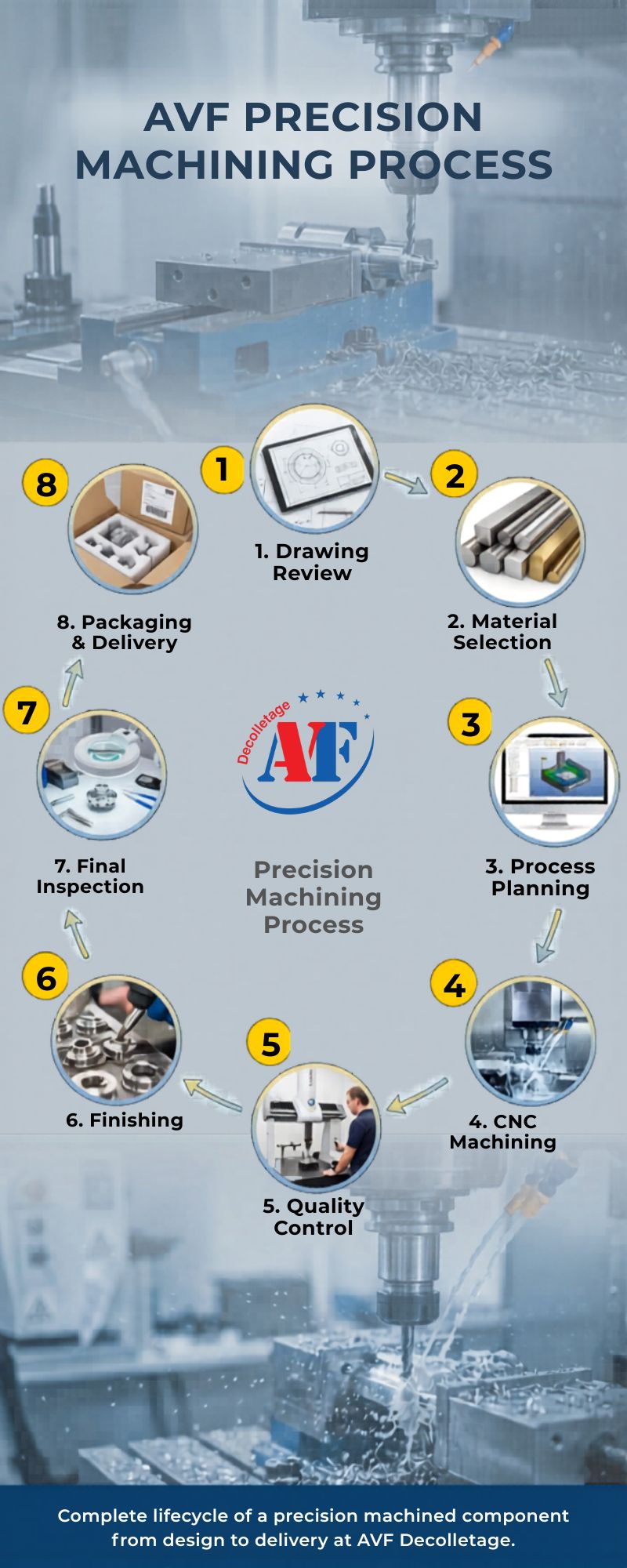
Conclusion: Mastering the Precision Machining Process
From drawing to delivery, precision machining is a system — not just a process.
Every step, from material selection to final inspection, plays a critical role in ensuring that parts meet performance, quality, and delivery expectations.
At AVF Decolletage, we combine advanced machining technology, experienced engineers, and strict quality systems to deliver components that meet the highest global standards.
Because true precision isn’t just in the part — it’s in the process behind it.
👉 Request a quote: https://avfdecolletage.com/request-for-quote/
Frequently Asked Questions (FAQ)
Q1: How long does the machining process take?
It depends on part complexity and volume, but typical lead times range from 2–6 weeks.
Q2: Can AVF Decolletage handle both prototypes and mass production?
Yes. We support both low-volume prototypes and high-volume production.
Q3: Do you provide full material traceability?
Yes. All materials are fully traceable with certification.
Q4: What industries do you serve?
We serve aerospace, automotive, electronics, industrial, and more.
Q5: Can AVF help optimize my design?
Absolutely. Our engineers regularly provide DFM support to improve cost and manufacturability.
🔗 Internal Links
- Services: https://avfdecolletage.com/services/
- Quality System: https://avfdecolletage.com/quality-system/
- Material List: https://avfdecolletage.com/avf-decolletage-material-list/
- RFQ: https://avfdecolletage.com/request-for-quote/