


By Franky Nguyen, AVF Decolletage
Introduction
In precision machining, success is often measured in microns — but not all dimensions are visible on a standard drawing.
Two of the most critical yet frequently misunderstood factors are concentricity and runout.
These geometric tolerances directly influence how parts rotate, align, and perform under real-world conditions.
In industries such as aerospace, automotive, electronics, and medical devices, even a small deviation can lead to vibration, premature wear, or complete system failure.
At AVF Decolletage, controlling concentricity and runout is part of our daily production discipline — especially for high-volume precision components produced on Swiss CNC and multi-spindle machines.
This article explains what these terms mean, how they differ, and why they are critical to the performance of precision machined parts.
👉 Explore AVF Decolletage precision machining capabilities
1️⃣ What Is Concentricity?
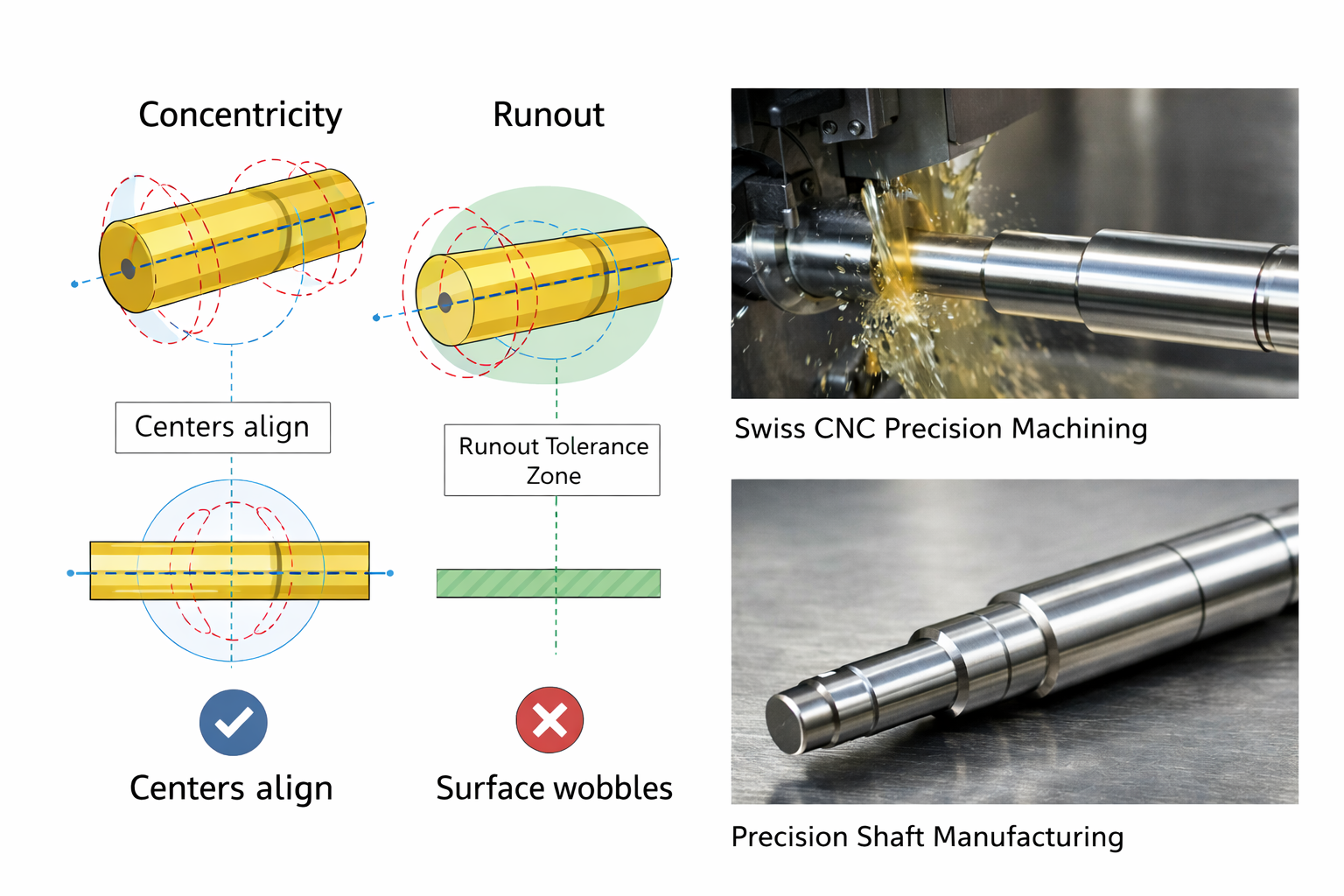
Concentricity refers to how closely the center axes of two or more cylindrical features align with each other.
In simple terms:
👉 If multiple diameters share the same centerline, they are concentric.
⚙️ Technical Definition
Concentricity controls the median points of diameters, ensuring that all circular features share a common axis within a specified tolerance zone.
📐 Why It Matters
When concentricity is not maintained:
- Rotating components become unbalanced
- Bearings experience uneven load
- Assemblies misalign under operation
🏭 Typical Applications
- Precision shafts
- Connector pins and contacts
- Valve components
- Rotational assemblies
AVF Insight:
In Swiss CNC machining, concentricity is often naturally controlled due to guide bushing support, but it still requires precise setup and tool alignment to maintain consistency across production runs.
2️⃣ What Is Runout?
While concentricity focuses on axis alignment, runout measures how much a surface deviates during rotation.
⚙️ Types of Runout
- Circular Runout: Measures variation at a single cross-section during rotation
- Total Runout: Measures variation across the entire surface length
📐 Simple Explanation
Imagine spinning a shaft:
- If it wobbles → that’s runout
- If its centers don’t align → that’s concentricity
🏭 Why Runout Is Critical
Excessive runout can cause:
- Vibration in high-speed assemblies
- Noise and wear in mechanical systems
- Poor electrical contact in connectors
- Seal failure in fluid systems
AVF Insight:
Runout is often more functionally important than concentricity because it directly reflects how a part behaves in motion.
3️⃣ Concentricity vs Runout — Key Differences
| Factor | Concentricity | Runout |
|---|---|---|
| Focus | Axis alignment | Surface deviation during rotation |
| Measurement | Complex (requires CMM) | Easier (dial indicator) |
| Functional impact | Alignment | Real-world rotation performance |
| Usage | Design intent | Functional verification |
👉 In modern manufacturing, many engineers prefer specifying runout instead of concentricity, as it is easier to measure and more relevant to performance.
4️⃣ How These Errors Occur in Machining
Even with advanced CNC systems, several factors can introduce variation:
🔧 1. Tool Wear
As tools degrade, cutting forces change, leading to slight deviations in geometry.
🔧 2. Improper Setup
Misalignment in collets, guide bushings, or spindles can create eccentric rotation.
🔧 3. Material Stress
Internal stresses in materials may release during machining, causing distortion.
🔧 4. Machine Vibration
Even minimal vibration can affect micro-level tolerances.
🔧 5. Multi-Operation Handling
Re-clamping parts between operations increases the risk of misalignment.
AVF Insight:
This is why single-setup machining (Swiss CNC) is preferred for high-precision components — it minimizes repositioning errors.
5️⃣ Controlling Concentricity and Runout in Production
At AVF Decolletage, we apply multiple layers of control:
✅ Machine Selection
Swiss CNC machines maintain alignment using guide bushings, ensuring stable axis control for long, slender parts.
✅ Tooling Optimization
- Balanced tool holders
- Sharp cutting edges
- Controlled cutting forces
✅ Process Planning
We design machining sequences to minimize re-clamping and secondary operations.
✅ In-Process Inspection
Operators check critical dimensions during production to detect deviation early.
✅ SPC Monitoring
Statistical Process Control ensures trends are identified before parts go out of tolerance.
6️⃣ Measurement and Inspection Techniques
📏 Dial Indicators
Used for quick runout checks on rotating parts.
📏 Coordinate Measuring Machines (CMM)
Required for precise concentricity evaluation.
📏 Vision Systems (Keyence)
Used for small components where contact measurement is not feasible.
📏 Custom Fixtures
Designed to hold parts securely during measurement.
AVF Insight:
For micro parts (below 1 mm), non-contact measurement systems are essential to avoid deformation during inspection.
7️⃣ Real-World Impact Across Industries
✈️ Aerospace
- Poor runout → vibration → structural fatigue
🚗 Automotive
- Misalignment → noise and wear in rotating assemblies
🔌 Electronics & Connectors
- Runout affects contact alignment and signal integrity
⚙️ Industrial Equipment
- Reduced lifespan of bearings and seals
8️⃣ Design Considerations for Engineers
To optimize manufacturability:
- Specify runout instead of concentricity when possible
- Avoid overly tight tolerances unless functionally required
- Design features for single-setup machining
- Use consistent datum references
AVF Insight:
A well-designed tolerance scheme can reduce cost by 20–30% without affecting performance.
Conclusion
Concentricity and runout are more than technical terms — they define how a part performs in motion.
While concentricity ensures proper alignment, runout determines real-world functionality.
Understanding the difference allows engineers and manufacturers to make smarter decisions in design, machining, and inspection.
At AVF Decolletage, we combine advanced machining technology, process control, and inspection systems to ensure every part meets the highest precision standards.
Because in precision manufacturing, true accuracy isn’t just measured — it’s controlled.
👉 Request technical consultation: https://avfdecolletage.com/request-for-quote/
Frequently Asked Questions (FAQ)
Q1: What is the difference between concentricity and runout?
Concentricity measures axis alignment, while runout measures variation during rotation.
Q2: Which is more important in real applications?
Runout is usually more critical because it reflects actual performance in motion.
Q3: Can Swiss CNC machines control these tolerances effectively?
Yes. Swiss CNC machines are ideal for maintaining tight concentricity and runout due to their stable support system.
Q4: How does AVF Decolletage measure these tolerances?
We use dial indicators, CMM systems, and vision inspection depending on part size and requirement.
Q5: Can tight tolerances increase machining cost?
Yes. Over-specifying concentricity or runout can significantly increase cost and production time.