


By Franky Nguyen, AVF Decolletage
Introduction
CNC machining tariffs are becoming one of the most important cost factors in global manufacturing in 2026.
For buyers sourcing precision machined components such as connector pins, housings, and high-volume parts, tariffs can significantly impact total landed cost—sometimes more than the machining itself.
What makes this even more challenging is that tariffs are not fixed. The duty you pay depends heavily on how your part is classified under the Harmonized System (HS code), not just the material or geometry.
At AVF Decolletage, we work closely with customers exporting to the United States, and one of the most common issues we see is unexpected cost increases due to incorrect HS code classification.
In this article, we break down:
- How tariffs apply to CNC machined parts
- Why HS code classification is critical
- Real examples of cost differences
- How buyers can reduce tariff exposure legally
Understanding CNC Machining Tariffs
Tariffs are import duties applied based on:
- Product classification (HS code)
- Material composition
- Country of origin
- Applicable trade policies
For CNC machined parts, especially those made from:
- Brass (C36000, C17300, C54400)
- Stainless steel (303, 304, 316)
- Aluminum (6061, 2017)
Tariff exposure can vary widely.
CNC Machining Tariffs and HS Code Classification
The Harmonized System (HS) determines how products are classified internationally.
👉 Official reference:
https://hts.usitc.gov/
For CNC machined parts, classification is not always obvious because:
- Parts can serve both mechanical and electrical functions
- Geometry does not define classification
- Function is often the deciding factor
Key HS Code Categories for CNC Machined Parts
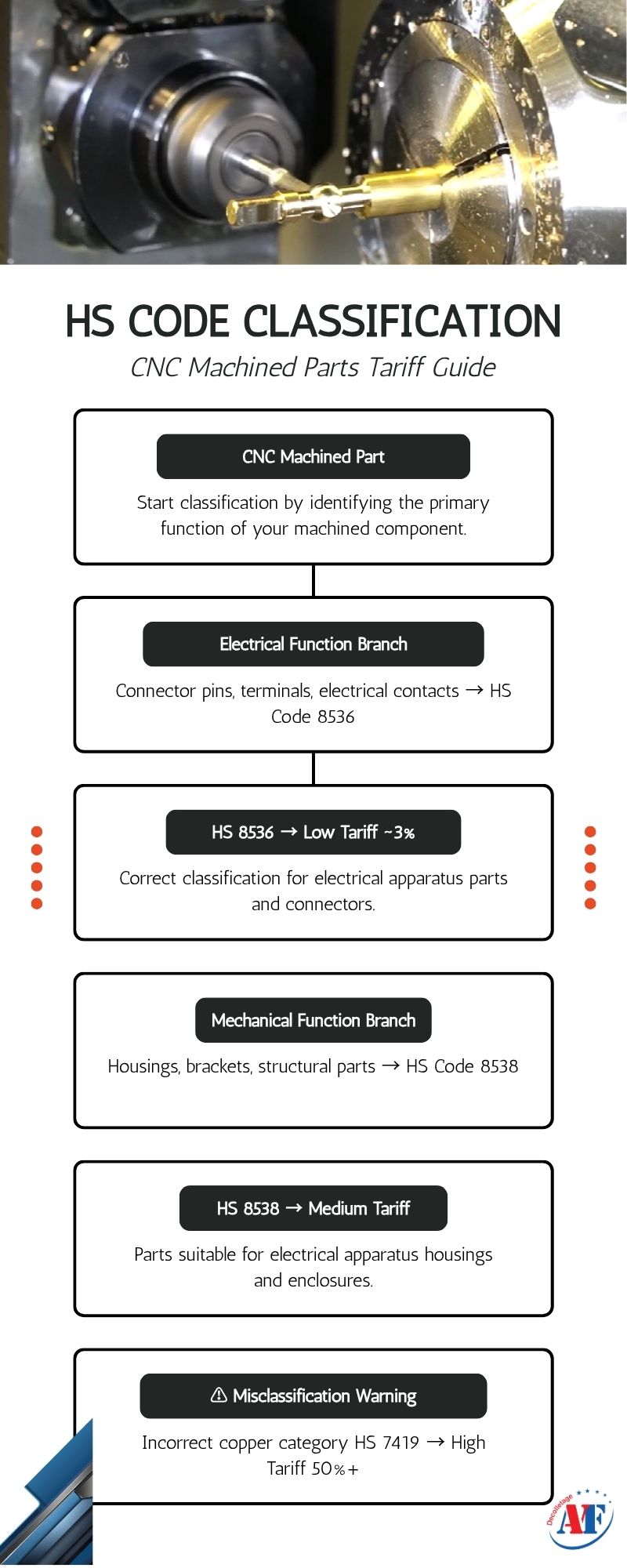
1. Electrical Components — Preferred Classification (When Applicable)
- HS Code: 8536.90.40.00
- Applies to:
- Connector pins
- Electrical contacts
- Terminals
👉 Requirement: The part must conduct or transmit electrical signals
Typical Duty: ~3%
Tariff Risk: Low
2. Parts of Electrical Equipment (Mechanical Role)
- HS Code: 8538.90.81.40
- Applies to:
- Connector housings
- Structural components
👉 These parts support electrical systems but do not carry current
Typical Duty: Higher depending on material
Tariff Risk: Medium
3. Copper / Metal-Based Classifications (High Risk)
- Example HS Code: 7419.99
⚠️ Risk:
- May trigger copper-related tariffs
- Total duty can exceed 50%+
Real-World Tariff Impact Examples
Case 1: Correct Classification
- Part: Brass connector pin
- HS Code: 8536
- Duty: ~3%
✔ Low cost
✔ Smooth customs clearance
Case 2: Incorrect Classification
- Same part
- Classified under copper category (7419)
❌ Duty: 50%+
❌ Significant cost increase
Case 3: Mechanical Reclassification
- Part: Connector housing
- HS Code: 8538
👉 Outcome:
- Higher base duty
- Possible exposure to additional tariffs
Key Insight
👉 The same part can have drastically different costs depending on classification.
For high-volume production, this difference can mean:
- Thousands to tens of thousands of dollars per shipment
Why Misclassification Happens
1. Classification Based on Material Instead of Function
Many assume:
- Brass → copper category
- Steel → steel category
But in reality:
👉 Function overrides material in many cases
2. Lack of Detailed Part Description
Generic descriptions like:
- “Metal component”
- “Machined part”
increase the risk of incorrect classification.
3. Misalignment Between Supplier and Importer
If:
- Supplier invoice
- Customs declaration
do not match → higher risk of reclassification and audits.
How to Reduce Tariff Exposure (Legally)
1. Clearly Define Part Function
Use descriptions such as:
- “Electrical contact”
- “Signal transmission pin”
- “Connector terminal”
2. Use Accurate and Specific Descriptions
Avoid vague terms. Instead, use:
- “Precision machined brass electrical contact for connector systems”
3. Align HS Code Strategy Early
Before production:
- Confirm classification
- Align with customs broker
- Validate with supplier
4. Work with Experienced Manufacturing Partners
At AVF Decolletage, we support customers by:
- Providing function-based part descriptions
- Sharing real shipment experience into the U.S.
- Helping reduce tariff risks during quoting stage
Why This Matters More Than Ever in 2026
Global trade policies are evolving rapidly:
- Expanded tariff coverage on metals
- Increased enforcement
- Greater scrutiny on classification
For industries such as:
- Aerospace
- Electronics
- Automotive
👉 Tariffs are now a major cost factor in sourcing decisions
Conclusion
Tariffs are no longer just a compliance issue—they are a strategic cost factor in CNC machining.
Understanding:
- HS code classification
- Function vs material logic
- Real tariff exposure
can help buyers:
- Avoid unnecessary costs
- Improve sourcing strategy
- Reduce risk in global supply chains
At AVF Decolletage, we work closely with customers to ensure not only precision machining—but also smarter, more cost-effective international sourcing.
FAQ Section
1. What is the most important factor in HS classification?
👉 Function of the part—not just material or shape.
2. Can the same part have different tariff rates?
Yes. Depending on classification, duty can range from ~3% to over 50%.
3. Where can I verify HS codes?
Use the official database:
https://hts.usitc.gov/
4. Are all brass parts subject to high tariffs?
No. Only if misclassified under copper-related categories.
5. How can I reduce tariff risk?
- Use correct classification
- Provide clear descriptions
- Work with experienced suppliers
🔗 Internal Links
Services: https://avfdecolletage.com/services/
Quality System: https://avfdecolletage.com/quality-system/
Material List: https://avfdecolletage.com/avf-decolletage-material-list/
RFQ: https://avfdecolletage.com/request-for-quote/